
Gelagen Ingredients: Every Nutrient Line, Milligram Breakdown & Research
Thirteen nutrient lines, every one with a printed amount. Here is what each does, how much the gummy delivers against what your body needs, and what the studies actually tested.
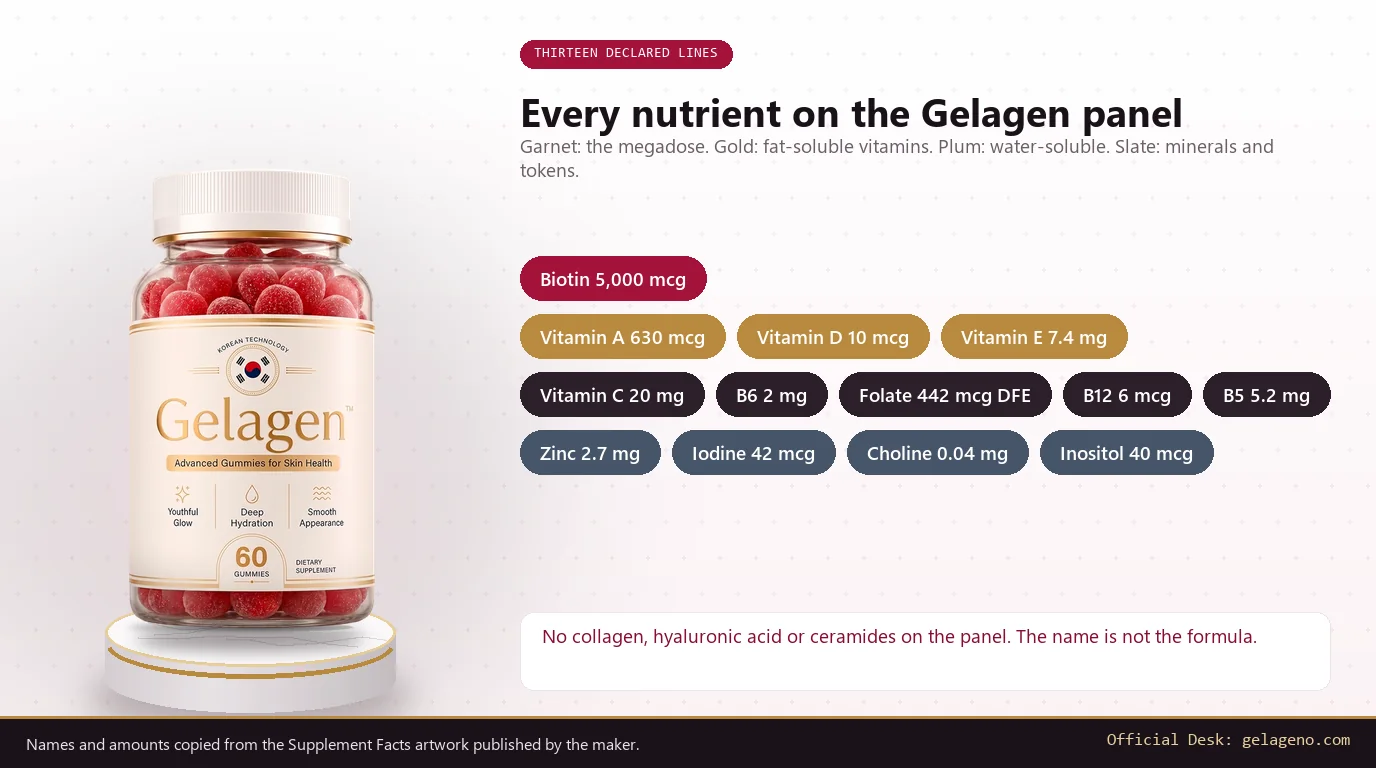
How to read this ingredient file
The Gelagen panel lists thirteen nutrient lines, and every one of them carries its own printed amount. That already puts it ahead of the many beauty supplements that hide their doses inside a "proprietary blend". It also means the useful questions are simple ones: how much of each nutrient is there, how that compares with what the body needs, and what the research tested when it reported an effect on skin, hair or nails.
We group the lines into five families: the biotin megadose, the fat-soluble vitamins (A, D, E), vitamin C, the B-vitamin set, and the minerals with two token entries. For each one you will find the form used, the amount per two-gummy serving, its share of the Daily Value, and a plain reading of the evidence. Daily Values come from the FDA's labeling table;[27] intake targets and upper limits come from the NIH Office of Dietary Supplements fact sheets linked at the bottom of the page.
The one-line verdict: a sensibly dosed multivitamin for skin, hair and nails, built around 5,000 mcg of biotin, with no collagen, no hyaluronic acid and only modest vitamin C and zinc.
Biotin 5,000 mcg: the headline ingredient
Form and amount. Free d-biotin, 5,000 mcg per serving, which the label converts to 16,667% of the Daily Value of 30 mcg. That figure looks alarming and is not, on its own, a toxicity signal: biotin is water-soluble, the gut absorbs it readily, and the surplus leaves in urine. No tolerable upper intake level has been set because no adverse effect has been documented from oral biotin at any studied dose.[1]
Why it is there. Biotin feeds five carboxylase enzymes that build fatty acids, break down several amino acids and make glucose. Hair bulbs and nail matrix cells are among the busiest tissues in the body, so when biotin is truly missing, thinning hair, brittle nails and a scaly rash around the eyes, nose and mouth appear early. Deficiency is uncommon in people who eat normally, but it does occur with biotinidase deficiency (an inherited condition), long-term heavy alcohol use, regular consumption of raw egg whites, and treatment with older anti-seizure drugs such as carbamazepine, phenytoin and phenobarbital. Pregnancy can also lower biotin status somewhat.[1]
What the research found. A 2017 review gathered every published report of biotin used for hair or nails and found eighteen cases, all of them in people with an underlying cause: an inherited biotin-handling disorder, uncombable hair syndrome, or brittle nail syndrome. In each, biotin helped. The authors found no evidence that it helps people without such a problem.[2] A comparative analysis published the same year reached the same conclusion and pointed out how far biotin's social media popularity runs ahead of its clinical support.[3] A Swiss study that measured biotin in women complaining of hair loss found low levels in a share of them, which argues for a simple blood test before assuming biotin is the answer.[4]
The strongest case is brittle nails. Two small uncontrolled studies from 1990 and 1993 gave 2,500 mcg a day for several months and reported firmer, thicker nails in many participants.[5][6] Gelagen provides twice that dose. There is no evidence that 5,000 mcg works better than 2,500 mcg, but there is no evidence it is harmful either, with one important practical exception.
The exception: laboratory tests. Many blood tests use biotin and streptavidin as a molecular glue. At milligram doses, circulating biotin can block that glue and push results falsely high or falsely low. In a controlled study, healthy volunteers taking 10 mg a day produced misleading results on several common hormone and non-hormone tests.[7] The practical rule is simple: tell every clinician and lab that you take a high-dose biotin product, and ask how long to pause it before testing.
Vitamin A 630 mcg as retinyl acetate
Form and amount. Retinyl acetate is preformed vitamin A, the same ester used in most multivitamins and in fortified milk and cereal. The 630 mcg is expressed as retinol activity equivalents (RAE) and equals 70% of the 900 mcg Daily Value. The adult recommended intake is 700 mcg for women and 900 mcg for men, and the tolerable upper intake level for preformed vitamin A is 3,000 mcg a day.[8]
Why it is there. In the body, retinyl acetate becomes retinol and then retinoic acid, which binds nuclear receptors that set the pace at which skin cells mature and shed. Deficiency produces dry, rough skin with plugged hair follicles, along with the better-known effects on night vision and immunity. Vitamin A also regulates the sebaceous glands, which is why the prescription retinoids made from it are acne drugs.
What the research found. Vitamin A is the clearest example in the hair literature of "more is not better". Reviews of nutrition and hair loss list excess vitamin A, usually from stacked supplements, among the few nutrient causes of shedding that are well documented.[9][10] At 630 mcg Gelagen sits comfortably in nutritional territory. The risk is additive: a second multivitamin, a prenatal, a daily serving of liver or cod liver oil, or a retinoid drug. People who are pregnant or could become pregnant should be especially careful, because high preformed vitamin A intake early in pregnancy is linked to birth defects.[8]
Vitamin C 20 mg
Form and amount. Ascorbic acid, 20 mg, which is 22% of the 90 mg Daily Value. Adult recommendations are 75 mg for women and 90 mg for men, with an extra 35 mg for smokers; the upper limit is 2,000 mg.[12] For scale, a medium orange supplies roughly 70 mg, and a cup of strawberries or a red bell pepper supplies more.
Why it is there. Vitamin C is the cofactor that keeps the enzymes prolyl hydroxylase and lysyl hydroxylase working. Without it, collagen chains cannot form stable cross-links, and the result, in scurvy, is fragile skin, poor wound healing and corkscrew-shaped hairs. Skin also stores high concentrations of vitamin C, where it acts as an antioxidant against ultraviolet and pollution stress.[11]
What the research found. A detailed review of vitamin C in skin health concluded that skin levels track dietary intake and that good vitamin C status supports collagen production and photoprotection; it also noted that most of the visible-benefit research used topical vitamin C or diets rich in fruit and vegetables rather than a small oral top-up.[11] In Gelagen, 20 mg is a supporting line, not the engine of the formula.
Vitamin E 7.4 mg and vitamin D 10 mcg
Vitamin E. The label uses d-alpha tocopheryl acetate, the natural-source ester, at 7.4 mg, or 49% of the 15 mg Daily Value. Vitamin E is the main fat-soluble antioxidant in cell membranes and is delivered to the skin surface in sebum. A dermatology review describes it as a useful ingredient in skincare and a reasonable nutrient to maintain, while noting that evidence for oral supplements visibly improving skin is mixed and mostly drawn from small studies.[13] The upper limit for supplemental vitamin E is 1,000 mg, more than a hundred times this dose, so the amount here raises no bleeding concerns.[14]
Vitamin D. Cholecalciferol (D3), 10 mcg or 400 IU, which is half of the 20 mcg Daily Value. The adult recommendation is 15 mcg to age 70 and 20 mcg after, and the upper limit is 100 mcg.[15] Vitamin D receptors are present in skin cells and hair follicles, and several studies report lower vitamin D levels in people with certain types of hair loss. Those studies show association, not proof that supplements regrow hair.[9] Many adults already take a separate vitamin D supplement; at 10 mcg, Gelagen adds modestly to it.
The B-vitamin set: B6, folate, B12 and pantothenic acid
Four B vitamins appear at 104% to 250% of the Daily Value. They are cheap to include, well tolerated, and important for the fast-dividing cells of skin, hair follicles and nail matrix.
| Line | Form | Amount | % DV | Adult target and limit |
|---|---|---|---|---|
| Vitamin B6 | Pyridoxine hydrochloride | 2 mg | 118% | RDA 1.3 to 1.7 mg; upper limit 100 mg |
| Folate | Folic acid 260 mcg | 442 mcg DFE | 111% | RDA 400 mcg DFE; upper limit 1,000 mcg folic acid |
| Vitamin B12 | Methylcobalamin | 6 mcg | 250% | RDA 2.4 mcg; no upper limit |
| Pantothenic acid (B5) | D-calcium pantothenate | 5.2 mg | 104% | Adequate intake 5 mg; no upper limit |
Folate arithmetic. Folic acid is absorbed more efficiently than food folate, so labels convert it to dietary folate equivalents: 260 mcg of folic acid multiplied by 1.7 gives the 442 mcg DFE printed on the panel.[16] One practical point for women planning a pregnancy: public health guidance recommends 400 mcg of folic acid a day, and Gelagen provides 260 mcg, so it is not a substitute for a prenatal vitamin.
B12. Methylcobalamin is one of the two active coenzyme forms. Deficiency, common in older adults and people on metformin or acid-reducing drugs, can cause skin hyperpigmentation, mouth sores and hair changes, and it should be diagnosed rather than masked. Folic acid can hide the anemia of B12 deficiency, which is a good reason to pair the two as Gelagen does.[17][16]
Pantothenic acid. B5 is part of coenzyme A, which skin needs to build its barrier lipids. The one randomized acne trial of a pantothenic acid supplement used a gram-range daily dose, hundreds of times the 5.2 mg here, so it says nothing about this gummy.[18]
Zinc 2.7 mg and iodine 42 mcg
Zinc. Zinc citrate, a well-absorbed form, at 2.7 mg, a quarter of the 11 mg Daily Value. Zinc is needed by hundreds of enzymes, including those in wound repair and keratin formation, and genuine deficiency causes hair shedding, skin lesions and slow healing. Deficiency risk is higher with vegetarian diets, gut disorders and heavy alcohol use.[19] Oral zinc for acne has been studied at 30 to 200 mg of elemental zinc a day, with mixed results and frequent stomach upset at the higher end; Gelagen's dose is far below that range.[20] The upper limit is 40 mg.
Iodine. Potassium iodide, 42 mcg, or 28% of the 150 mcg Daily Value. Iodine is used to make thyroid hormones, and thyroid disorders are themselves a cause of dry skin, brittle hair and diffuse hair loss. The upper limit is 1,100 mcg. People with thyroid disease, or those taking thyroid medication, should include this line when they count their total iodine.[21]
Gummies rarely carry large mineral doses, because minerals taste metallic and destabilize the gel. That is a format limitation, not a choice unique to Gelagen, but it explains why there is no iron, calcium, magnesium or selenium on the panel. Iron in particular matters for hair, and it should be tested, not guessed.
Choline, inositol and the gummy base
Two lines are too small to affect anything. Choline bitartrate supplies 0.04 mg against a Daily Value of 550 mg, which rounds to 0%. Inositol appears at 40 mcg with no Daily Value at all. Their presence lengthens the label more than it changes the formula.
The base matters more. In order of weight: corn syrup, water, pure cane sugar, pectin, citric acid, natural flavor, sodium citrate, tapioca starch and beet root extract for the red color. Together they deliver 10 calories, 3 g of total sugar (all of it added, 6% of the Daily Value) and 10 mg of sodium per serving.[23] Pectin and tapioca starch are plant-based gelling agents, so the label lists no gelatin. Researchers have connected high-sugar diets with glycation of skin collagen, the process that stiffens fibers with age.[22] Three grams a day is a small part of anyone's sugar intake, but it is a fair reason to take the gummies with water rather than as an evening treat.
What is not in Gelagen, and why that matters
The name sounds like gelatin or collagen, and the front of the bottle promises Youthful Glow, Deep Hydration and Smooth Appearance. These are the ingredients a skin-focused shopper might expect from that wording, and none of them is on the panel.
| Ingredient | In Gelagen? | What the research used |
|---|---|---|
| Collagen peptides | No | 2.5 to 10 g a day for 8 to 12 weeks in skin trials |
| Hyaluronic acid | No | About 120 mg a day in a dry-skin trial |
| Ceramides | No | Plant ceramide extracts in small skin-hydration studies |
| Iron | No | Only useful when iron stores are low; needs a blood test |
| Silica, keratin, MSM, saw palmetto | No | Popular in hair products; evidence is thin |
The collagen gap is the most important. A 2021 meta-analysis of nineteen randomized trials found that hydrolyzed collagen taken for about three months improved measured skin hydration and elasticity,[24] and one well-known trial found benefits from 2.5 to 5 g of specific collagen peptides in women aged 35 to 55.[25] Oral hyaluronic acid has been tested at around 120 mg a day.[26] Two small gummies could not hold gram amounts of collagen even if the formula wanted to. If those outcomes are what you are after, a collagen powder is a different product category.
Every line against the adult target and the upper limit
| Nutrient | Per 2 gummies | % DV | Adult target | Upper limit |
|---|---|---|---|---|
| Biotin | 5,000 mcg | 16,667% | 30 mcg (AI) | None set |
| Vitamin A (preformed) | 630 mcg RAE | 70% | 700 to 900 mcg | 3,000 mcg |
| Vitamin C | 20 mg | 22% | 75 to 90 mg | 2,000 mg |
| Vitamin D3 | 10 mcg | 50% | 15 to 20 mcg | 100 mcg |
| Vitamin E | 7.4 mg | 49% | 15 mg | 1,000 mg |
| Vitamin B6 | 2 mg | 118% | 1.3 to 1.7 mg | 100 mg |
| Folate | 442 mcg DFE | 111% | 400 mcg DFE | 1,000 mcg folic acid |
| Vitamin B12 | 6 mcg | 250% | 2.4 mcg | None set |
| Pantothenic acid | 5.2 mg | 104% | 5 mg (AI) | None set |
| Choline | 0.04 mg | 0% | 425 to 550 mg | 3,500 mg |
| Iodine | 42 mcg | 28% | 150 mcg | 1,100 mcg |
| Zinc | 2.7 mg | 25% | 8 to 11 mg | 40 mg |
| Inositol | 40 mcg | none | No target | None set |
Read across any row and the pattern is clear: everything sits at or near a nutritional level except biotin, and nothing approaches an upper limit when Gelagen is taken alone. The only way into trouble is stacking it with other products that repeat the same lines.
Questions readers ask about this
What is the main ingredient in Gelagen?
Biotin, at 5,000 mcg per two-gummy serving. Every other line is a vitamin or mineral at roughly nutritional levels, from 22% to 250% of the Daily Value.
Does Gelagen have collagen or hyaluronic acid?
No. The panel lists neither, nor ceramides or gelatin. The gummy is set with pectin and tapioca starch.
Is 5,000 mcg of biotin too much?
It is not toxic as far as research shows, and no upper limit exists. The practical problem is laboratory interference, so tell your clinician and the lab before any blood test.
Is Gelagen vegan?
The label lists no animal ingredients: pectin rather than gelatin, and plant starches. It does not carry a vegan certification, and the natural flavor is not specified, so ask support if that matters to you.
Can I take Gelagen with a multivitamin?
Usually you should not need both. Combining them roughly doubles vitamin A and folic acid and adds more biotin. If you do combine them, add up vitamin A and folic acid against their upper limits first.
Sources behind this page
Each link opens the original abstract or agency page. The studies tested single nutrients, often in people who were deficient or had a diagnosed condition; none tested the Gelagen gummy itself.
- 1NIH Office of Dietary Supplements. Biotin: Fact Sheet for Health Professionals. ods.od.nih.gov/factsheets/Biotin-HealthProfessional/
- 2Patel DP, Swink SM, Castelo-Soccio L. A review of the use of biotin for hair loss. Skin Appendage Disord. 2017;3(3):166-169. pubmed.ncbi.nlm.nih.gov/28879195/
- 3Soleymani T, Lo Sicco K, Shapiro J. The infatuation with biotin supplementation: is there truth behind its rising popularity? A comparative analysis of clinical efficacy versus social popularity. J Drugs Dermatol. 2017;16(5):496-500. pubmed.ncbi.nlm.nih.gov/28628687/
- 4Trüeb RM. Serum biotin levels in women complaining of hair loss. Int J Trichology. 2016;8(2):73-77. pubmed.ncbi.nlm.nih.gov/27601860/
- 5Colombo VE, Gerber F, Bronhofer M, Floersheim GL. Treatment of brittle fingernails and onychoschizia with biotin: scanning electron microscopy. J Am Acad Dermatol. 1990;23(6 Pt 1):1127-1132. pubmed.ncbi.nlm.nih.gov/2273113/
- 6Hochman LG, Scher RK, Meyerson MS. Brittle nails: response to daily biotin supplementation. Cutis. 1993;51(4):303-305. pubmed.ncbi.nlm.nih.gov/8477615/
- 7Li D, Radulescu A, Shrestha RT, et al. Association of biotin ingestion with performance of hormone and nonhormone assays in healthy adults. JAMA. 2017;318(12):1150-1160. pubmed.ncbi.nlm.nih.gov/28973622/
- 8NIH Office of Dietary Supplements. Vitamin A and Carotenoids: Fact Sheet for Health Professionals. ods.od.nih.gov/factsheets/VitaminA-HealthProfessional/
- 9Almohanna HM, Ahmed AA, Tsatalis JP, Tosti A. The role of vitamins and minerals in hair loss: a review. Dermatol Ther (Heidelb). 2019;9(1):51-70. pubmed.ncbi.nlm.nih.gov/30547302/
- 10Guo EL, Katta R. Diet and hair loss: effects of nutrient deficiency and supplement use. Dermatol Pract Concept. 2017;7(1):1-10. pubmed.ncbi.nlm.nih.gov/28243487/
- 11Pullar JM, Carr AC, Vissers MCM. The roles of vitamin C in skin health. Nutrients. 2017;9(8):866. pubmed.ncbi.nlm.nih.gov/28805671/
- 12NIH Office of Dietary Supplements. Vitamin C: Fact Sheet for Health Professionals. ods.od.nih.gov/factsheets/VitaminC-HealthProfessional/
- 13Keen MA, Hassan I. Vitamin E in dermatology. Indian Dermatol Online J. 2016;7(4):311-315. pubmed.ncbi.nlm.nih.gov/27559512/
- 14NIH Office of Dietary Supplements. Vitamin E: Fact Sheet for Health Professionals. ods.od.nih.gov/factsheets/VitaminE-HealthProfessional/
- 15NIH Office of Dietary Supplements. Vitamin D: Fact Sheet for Health Professionals. ods.od.nih.gov/factsheets/VitaminD-HealthProfessional/
- 16NIH Office of Dietary Supplements. Folate: Fact Sheet for Health Professionals. ods.od.nih.gov/factsheets/Folate-HealthProfessional/
- 17NIH Office of Dietary Supplements. Vitamin B12: Fact Sheet for Health Professionals. ods.od.nih.gov/factsheets/VitaminB12-HealthProfessional/
- 18Yang M, Moclair B, Hatcher V, et al. A randomized, double-blind, placebo-controlled study of a novel pantothenic acid-based dietary supplement in subjects with mild to moderate facial acne. Dermatol Ther (Heidelb). 2014;4(1):93-101. pubmed.ncbi.nlm.nih.gov/24831048/
- 19NIH Office of Dietary Supplements. Zinc: Fact Sheet for Health Professionals. ods.od.nih.gov/factsheets/Zinc-HealthProfessional/
- 20Cervantes J, Eber AE, Perper M, Nascimento VM, Nouri K, Keri JE. The role of zinc in the treatment of acne: a review of the literature. Dermatol Ther. 2018;31(1):e12576. pubmed.ncbi.nlm.nih.gov/29193602/
- 21NIH Office of Dietary Supplements. Iodine: Fact Sheet for Health Professionals. ods.od.nih.gov/factsheets/Iodine-HealthProfessional/
- 22Danby FW. Nutrition and aging skin: sugar and glycation. Clin Dermatol. 2010;28(4):409-411. pubmed.ncbi.nlm.nih.gov/20620757/
- 23U.S. Food and Drug Administration. Added Sugars on the Nutrition Facts Label. www.fda.gov/food/nutrition-facts-label/added-sugars-nutrition-facts-label
- 24de Miranda RB, Weimer P, Rossi RC. Effects of hydrolyzed collagen supplementation on skin aging: a systematic review and meta-analysis. Int J Dermatol. 2021;60(12):1449-1461. pubmed.ncbi.nlm.nih.gov/33742704/
- 25Proksch E, Segger D, Degwert J, Schunck M, Zague V, Oesser S. Oral supplementation of specific collagen peptides has beneficial effects on human skin physiology: a double-blind, placebo-controlled study. Skin Pharmacol Physiol. 2014;27(1):47-55. pubmed.ncbi.nlm.nih.gov/23949208/
- 26Kawada C, Yoshida T, Yoshida H, et al. Ingested hyaluronan moisturizes dry skin. Nutr J. 2014;13:70. pubmed.ncbi.nlm.nih.gov/25014997/
- 27U.S. Food and Drug Administration. Daily Value on the Nutrition and Supplement Facts Labels. www.fda.gov/food/nutrition-facts-label/daily-value-nutrition-and-supplement-facts-labels
Give Gelagen a fair 60-day trial
Payment happens on the seller's BuyGoods checkout. Take two gummies a day as the label says, photograph your nails and hairline in the same light on day one, tell your doctor about the biotin before any blood test, and if the photos look the same around day 50, email the refund request while the window is open.