
How Gelagen Works: Biological Mechanisms, Cellular Pathways & Trial Evidence
Five nutrient pathways explained in plain language, each matched with the human evidence and an honest grade for every claim on the bottle.
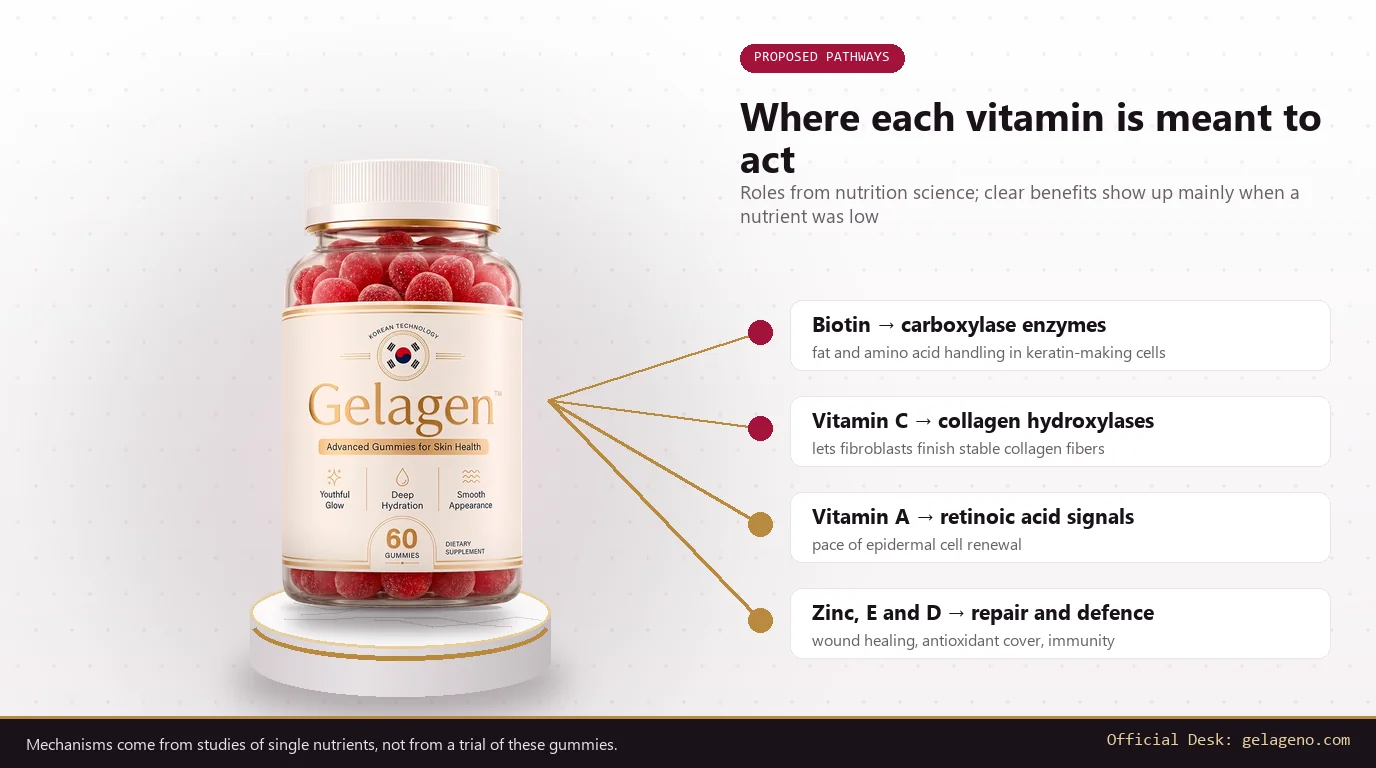
The short version
Gelagen does not work through a new mechanism. It works, when it works, by making sure the cells that build skin, hair and nails are not short of the vitamins and minerals they use every day. Each ingredient has a well-mapped job, which we walk through below. The limit of the approach is just as well mapped: once a nutrient is adequate, more of it does not make those cells build faster or better. The body excretes the surplus of water-soluble vitamins and stores the surplus of fat-soluble ones.[21]
That gives a clear way to predict your own result. If your diet is short on fruit, vegetables, eggs, meat or dairy, or you have a condition that lowers absorption, Gelagen may close a real gap and the effects will show slowly in new growth. If your intake is already good, the realistic expectation is little or no visible change.
Pathway 1: biotin and the keratin factory
Biotin is bound to five carboxylase enzymes inside cells. Acetyl-CoA carboxylase starts fatty acid synthesis; pyruvate carboxylase helps make glucose; propionyl-CoA and methylcrotonyl-CoA carboxylases break down certain amino acids and odd-chain fats. These are housekeeping reactions, but they matter most in tissues that divide quickly and need a constant supply of lipids and energy, and the hair bulb and nail matrix are two of the fastest-dividing tissues in the body.[1]
When biotin is missing, these enzymes slow, and the visible signs follow: thinning hair, brittle nails and a characteristic scaly rash around the eyes, nose and mouth. Restoring biotin restores the enzymes, and in documented deficiency, hair and nails recover. This is the mechanism behind every successful case in the biotin literature.[2]
What the mechanism does not provide is a route to extra growth. The carboxylases are saturated at normal biotin levels; adding 167 times the adequate intake does not make them work harder. The surplus circulates in the blood, which is exactly why it interferes with biotin-based laboratory tests, and then leaves in urine.[20]
Pathway 2: vitamin C and collagen assembly
Skin's strength comes from collagen made by fibroblasts in the dermis. Each collagen chain has to be modified before three of them can twist into a stable triple helix, and two enzymes that do that work, prolyl hydroxylase and lysyl hydroxylase, need vitamin C to stay active. Vitamin C also appears to switch on collagen gene expression in fibroblasts and acts as an antioxidant that soaks up some of the reactive molecules ultraviolet light produces.[3]
This is why supplement marketing so often says that vitamin C "supports collagen". It is true in the sense that the body cannot make collagen properly without it. It is not true in the sense of adding collagen, and the effect only scales up to the point where vitamin C is adequate. Gelagen supplies 20 mg, roughly a quarter of the daily requirement; the rest has to come from food, which for most people it already does.
Pathway 3: vitamin A and epidermal turnover
The outer skin is replaced from below. New keratinocytes form in the basal layer and spend weeks moving to the surface, maturing as they go, before they flatten and shed. Retinoic acid, made in the body from the retinyl acetate in Gelagen, binds retinoic acid receptors in the cell nucleus and helps set the pace and quality of that maturation. It also regulates sebaceous glands and supports the skin's immune defences.[4]
Too little vitamin A shows up as dry, rough skin with plugged hair follicles. Too much, over months, also shows up in skin and hair, as dryness, peeling and shedding.[5] The prescription retinoids dermatologists use (tretinoin creams, oral isotretinoin) push this same pathway much harder than any nutritional dose can. Gelagen's 630 mcg is designed to keep the pathway supplied, not to act like a retinoid drug.
Pathway 4: zinc, vitamin E and vitamin D as the support crew
Zinc is a structural part of hundreds of enzymes, including the metalloproteinases that remodel tissue during wound healing and enzymes needed for DNA synthesis in dividing cells. Deficiency produces shedding and slow-healing skin, and correcting it reverses both.[7]
Vitamin E protects the fats in cell membranes from oxidation. Sebaceous glands secrete it to the skin surface, where it forms part of the skin's antioxidant layer. Most of the benefit research is on topical vitamin E; oral effects on appearance are modest and inconsistent.[8]
Vitamin D is made in the skin itself and acts back on it: keratinocytes and hair follicle cells carry vitamin D receptors, and the receptor plays a role in the hair growth cycle. Low vitamin D levels turn up more often in some forms of hair loss, but supplementation trials have not shown that taking vitamin D restores hair in people who are not deficient.[9][6]
Pathway 5: the B vitamins and fast-dividing cells
Folate and vitamin B12 work together to make the building blocks of DNA. Cells that divide constantly, in bone marrow, the gut lining, hair bulbs and nail matrix, are the first to suffer when either is short, which is why deficiency can bring mouth sores, skin pigment changes and hair problems along with anemia.[10][11] Vitamin B6 is needed for amino acid metabolism, including the amino acids that become keratin. Pantothenic acid is part of coenzyme A, which skin uses to build the fats that form its water barrier.
At 104% to 250% of the Daily Value, Gelagen fully covers these needs for most adults. The same logic applies as everywhere else on the label: a person short on B12 because of diet, age or medication may see a real difference once it is corrected, and that person should also have the deficiency diagnosed, because its cause matters.
What the gummy cannot reach: the skin aging exposome
Dermatologists now describe skin aging through the exposome: the sum of outside and lifestyle factors that act on skin across a lifetime. Sun exposure dominates the list, followed by air pollution, tobacco smoke, nutrition, sleep, stress and temperature.[12] A multivitamin touches one item on that list.
| Factor | What the evidence shows | Where Gelagen fits |
|---|---|---|
| Daily sunscreen | In a 4.5-year randomized trial, regular users showed no detectable increase in skin aging | Not addressed; no gummy replaces sunscreen |
| Sleep | Poor sleepers showed more signs of intrinsic aging and slower barrier recovery | Not addressed |
| Sugar intake | High-sugar diets linked to glycation of skin collagen | Adds 3 g of sugar per serving |
| Water intake | Extra water improved skin hydration in people who drank little | The label's glass of water helps here |
| Micronutrients | Deficiencies cause skin, hair and nail changes | This is Gelagen's job |
The sources behind the table are a sunscreen trial,[13] a sleep study,[14] a review of sugar and glycation,[15] a water-intake study[16] and a broad review of anti-aging strategies.[17] The practical point: if you are going to spend effort on your skin, sunscreen and sleep will return more than any supplement, this one included.
Who is most likely to respond
Because every pathway on this page depends on a gap being present, the useful question is who tends to have gaps. The groups below are the ones where a broad skin, hair and nail multivitamin has the best chance of producing a visible difference, and also the groups where a proper diagnosis matters most.
- Restrictive or very low-calorie diets. Crash dieting is a classic trigger for shedding two to three months later, and it lowers intake of almost every nutrient on this label at once.
- Older adults. Stomach acid falls with age, and B12 absorption from food falls with it; acid-reducing drugs and metformin lower it further.[11]
- Pregnancy and the months after birth. Biotin status can dip in pregnancy, and postpartum shedding is common, but vitamin A must be counted carefully and a prenatal vitamin is the right base.[1][4]
- Gut conditions and weight-loss surgery. Coeliac disease, inflammatory bowel disease and bariatric surgery all reduce absorption of zinc, B12, folate and the fat-soluble vitamins.
- Heavy alcohol use and certain medicines. Alcohol lowers biotin, zinc and folate status, and older anti-seizure drugs lower biotin.[1][7]
For anyone in these groups, the better first step is a short blood panel: ferritin (iron stores), vitamin D, B12, a thyroid test and sometimes zinc. Iron and thyroid problems are among the commonest causes of diffuse hair loss and Gelagen addresses neither. If you take Gelagen before the blood draw, tell the lab, because the biotin can distort the thyroid result.[20]
Evidence grade for each marketing claim
The front of the bottle promises Youthful Glow, Deep Hydration and Smooth Appearance, and the sales page talks about radiant skin, stronger hair and healthier nails. Here is how each claim holds up against the ingredient list and the published research.
| Claim | Plausible mechanism? | Human evidence | Our grade |
|---|---|---|---|
| Stronger, less brittle nails | Yes, biotin and the B set | Small uncontrolled studies in people with brittle nails | C |
| Less hair shedding | Only if a nutrient was low | Case reports in deficiency; none in healthy people | C- for deficiency, D otherwise |
| Healthier-looking skin | Yes, vitamins A, C, E and zinc | Deficiency correction; little for well-nourished adults | D |
| Deep hydration | No humectant on the label | None for this formula | F |
| Collagen support | Vitamin C cofactor only; no collagen supplied | Collagen trials used collagen peptides, absent here | D |
| Youthful glow | Undefined | None | Not gradable |
The grades describe evidence for the ingredients at these doses, not a verdict on any one buyer's results. A grade of C means a small, plausible signal in a specific group; D means the mechanism exists but human evidence in healthy people is missing; F means the claim has no ingredient behind it. For comparison, collagen peptides for skin elasticity and hydration would earn a B on the strength of a 19-trial meta-analysis,[18] which is a fair benchmark for what this gummy is not.
How the timing works in practice
Every mechanism above acts on new tissue, not on hair and nail that already exist. A hair shaft is dead keratin from the moment it leaves the follicle, and a nail plate is the same. That fixes the earliest possible result to the speed of growth: fingernails grow roughly three millimetres a month, and scalp hair roughly a centimetre. Shedding follows its own clock: hairs that entered the resting phase months ago will fall regardless of what you start today, and the dermatology guidance is that a normal day sheds 50 to 100 hairs.[19]
So the realistic order of events, if Gelagen helps you at all, is this: nothing for two to four weeks, then a firmer band at the base of the nails, then, after three months or more, less shedding and thicker regrowth if a deficiency was part of the cause. Skin dryness can move faster, but it also changes with weather, water intake and skincare, which makes it the hardest result to attribute.
Questions readers ask about this
Does Gelagen boost collagen?
Not directly. It supplies vitamin C, which the body needs to build its own collagen, at about a quarter of the daily requirement. It contains no collagen itself.
Will more biotin grow hair faster?
No. Biotin enzymes are saturated at normal levels. Extra biotin helps only when there was a deficiency, and the surplus mainly ends up interfering with lab tests and leaving in urine.
Is Gelagen like a retinol cream?
No. Its vitamin A is a nutritional dose that keeps the normal pathway supplied. Retinoid creams and pills deliver far stronger signals and are prescription or cosmetic products with their own risks.
Why does the label say Deep Hydration?
It is marketing language. Nothing on the panel is a humectant such as hyaluronic acid or ceramides. The glass of water in the directions is the only hydrating step.
How soon could I notice anything?
Nails first, after three to six weeks, at the base. Hair takes three months or longer. If nothing has changed by about day 50, decide on the refund before day 60.
Sources behind this page
Each link opens the original abstract or agency page. The studies tested single nutrients, often in people who were deficient or had a diagnosed condition; none tested the Gelagen gummy itself.
- 1NIH Office of Dietary Supplements. Biotin: Fact Sheet for Health Professionals. ods.od.nih.gov/factsheets/Biotin-HealthProfessional/
- 2Patel DP, Swink SM, Castelo-Soccio L. A review of the use of biotin for hair loss. Skin Appendage Disord. 2017;3(3):166-169. pubmed.ncbi.nlm.nih.gov/28879195/
- 3Pullar JM, Carr AC, Vissers MCM. The roles of vitamin C in skin health. Nutrients. 2017;9(8):866. pubmed.ncbi.nlm.nih.gov/28805671/
- 4NIH Office of Dietary Supplements. Vitamin A and Carotenoids: Fact Sheet for Health Professionals. ods.od.nih.gov/factsheets/VitaminA-HealthProfessional/
- 5Guo EL, Katta R. Diet and hair loss: effects of nutrient deficiency and supplement use. Dermatol Pract Concept. 2017;7(1):1-10. pubmed.ncbi.nlm.nih.gov/28243487/
- 6Almohanna HM, Ahmed AA, Tsatalis JP, Tosti A. The role of vitamins and minerals in hair loss: a review. Dermatol Ther (Heidelb). 2019;9(1):51-70. pubmed.ncbi.nlm.nih.gov/30547302/
- 7NIH Office of Dietary Supplements. Zinc: Fact Sheet for Health Professionals. ods.od.nih.gov/factsheets/Zinc-HealthProfessional/
- 8Keen MA, Hassan I. Vitamin E in dermatology. Indian Dermatol Online J. 2016;7(4):311-315. pubmed.ncbi.nlm.nih.gov/27559512/
- 9NIH Office of Dietary Supplements. Vitamin D: Fact Sheet for Health Professionals. ods.od.nih.gov/factsheets/VitaminD-HealthProfessional/
- 10NIH Office of Dietary Supplements. Folate: Fact Sheet for Health Professionals. ods.od.nih.gov/factsheets/Folate-HealthProfessional/
- 11NIH Office of Dietary Supplements. Vitamin B12: Fact Sheet for Health Professionals. ods.od.nih.gov/factsheets/VitaminB12-HealthProfessional/
- 12Krutmann J, Bouloc A, Sore G, Bernard BA, Passeron T. The skin aging exposome. J Dermatol Sci. 2017;85(3):152-161. pubmed.ncbi.nlm.nih.gov/27720464/
- 13Hughes MC, Williams GM, Baker P, Green AC. Sunscreen and prevention of skin aging: a randomized trial. Ann Intern Med. 2013;158(11):781-790. pubmed.ncbi.nlm.nih.gov/23732711/
- 14Oyetakin-White P, Suggs A, Koo B, et al. Does poor sleep quality affect skin ageing? Clin Exp Dermatol. 2015;40(1):17-22. pubmed.ncbi.nlm.nih.gov/25266053/
- 15Danby FW. Nutrition and aging skin: sugar and glycation. Clin Dermatol. 2010;28(4):409-411. pubmed.ncbi.nlm.nih.gov/20620757/
- 16Palma L, Marques LT, Bujan J, Rodrigues LM. Dietary water affects human skin hydration and biomechanics. Clin Cosmet Investig Dermatol. 2015;8:413-421. pubmed.ncbi.nlm.nih.gov/26345226/
- 17Ganceviciene R, Liakou AI, Theodoridis A, Makrantonaki E, Zouboulis CC. Skin anti-aging strategies. Dermatoendocrinol. 2012;4(3):308-319. pubmed.ncbi.nlm.nih.gov/23467476/
- 18de Miranda RB, Weimer P, Rossi RC. Effects of hydrolyzed collagen supplementation on skin aging: a systematic review and meta-analysis. Int J Dermatol. 2021;60(12):1449-1461. pubmed.ncbi.nlm.nih.gov/33742704/
- 19American Academy of Dermatology Association. Hair shedding. www.aad.org/public/diseases/hair-loss/insider/shedding
- 20Li D, Radulescu A, Shrestha RT, et al. Association of biotin ingestion with performance of hormone and nonhormone assays in healthy adults. JAMA. 2017;318(12):1150-1160. pubmed.ncbi.nlm.nih.gov/28973622/
- 21NIH Office of Dietary Supplements. Multivitamin/mineral Supplements: Fact Sheet for Health Professionals. ods.od.nih.gov/factsheets/MVMS-HealthProfessional/
- 22U.S. Food and Drug Administration. Questions and Answers on Dietary Supplements. www.fda.gov/food/information-consumers-using-dietary-supplements/questions-and-answers-dietary-supplements
Give Gelagen a fair 60-day trial
Payment happens on the seller's BuyGoods checkout. Take two gummies a day as the label says, photograph your nails and hairline in the same light on day one, tell your doctor about the biotin before any blood test, and if the photos look the same around day 50, email the refund request while the window is open.