
Vitamin C and Skin: The Collagen Cofactor, Explained Simply
Every claim that a vitamin supports collagen goes back to one enzyme reaction. Here is that reaction, and what it means for your shopping list.
The reaction that needs vitamin C
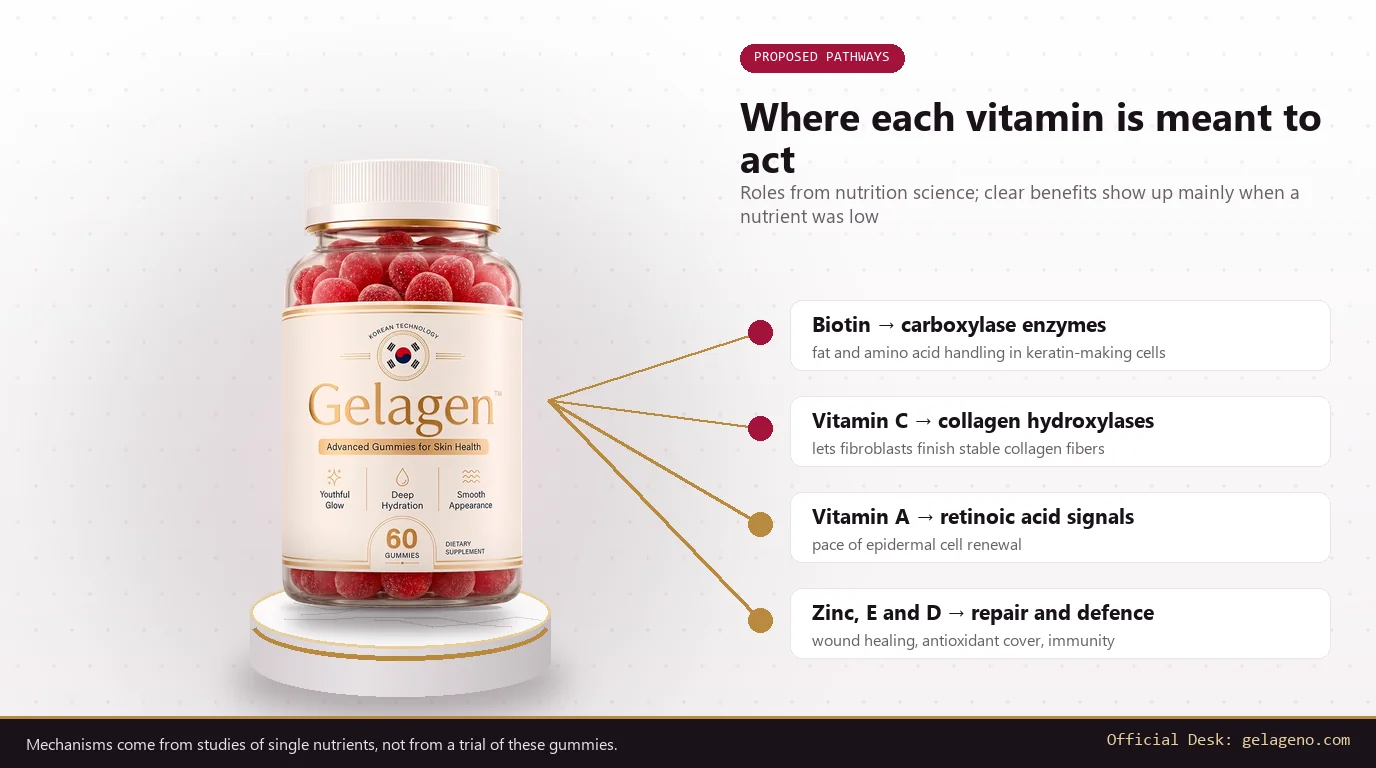
Collagen chains are rich in the amino acids proline and lysine. Before three chains can twist into a stable fiber, enzymes must add hydroxyl groups to many of those residues. Prolyl and lysyl hydroxylases do that work, and they need vitamin C to keep their iron atom in the active state. Without enough vitamin C, collagen comes out weak, which is why scurvy causes fragile skin, bleeding gums and slow-healing wounds.[1]
Where vitamin C acts
Antioxidant protection
Skin holds high concentrations of vitamin C, where it helps neutralize reactive molecules produced by ultraviolet light and pollution. Skin levels fall with sun exposure and rise with dietary intake.[1] It is one small part of the defense; sunscreen remains the intervention with trial evidence for slowing visible aging.[3][4]
How much is enough
| Source | Approximate vitamin C |
|---|---|
| Adult Daily Value | 90 mg |
| One medium orange | About 70 mg |
| Half a cup of red bell pepper | About 95 mg |
| Gelagen, two gummies | 20 mg |
| Upper limit | 2,000 mg |
Figures for foods are approximate values from the NIH vitamin C fact sheet.[2] A single serving of fruit or vegetables usually provides more vitamin C than a beauty gummy.
Practical takeaways
- Eat at least two servings of vitamin C-rich produce a day; it covers the collagen cofactor role.
- Use sunscreen daily; it protects the collagen you have.
- Treat the 20 mg in Gelagen as a top-up, not the main source.
More on each Gelagen ingredient in our mechanism file.
Quick questions on this topic
Does oral vitamin C improve wrinkles?
Good vitamin C status supports collagen production, but most adults already get enough from food. Visible-benefit studies mostly involve topical vitamin C or diets rich in produce.
Is 20 mg of vitamin C enough?
No, not on its own. It is about 22% of the Daily Value; fruit and vegetables usually provide the rest.
Can too much vitamin C hurt?
The adult upper limit is 2,000 mg a day; above that, stomach upset and diarrhea become more likely. A gummy with 20 mg is nowhere near it.
Sources behind this page
Each link opens the original abstract or agency page. The studies tested single nutrients, often in people who were deficient or had a diagnosed condition; none tested the Gelagen gummy itself.
- 1Pullar JM, Carr AC, Vissers MCM. The roles of vitamin C in skin health. Nutrients. 2017;9(8):866. pubmed.ncbi.nlm.nih.gov/28805671/
- 2NIH Office of Dietary Supplements. Vitamin C: Fact Sheet for Health Professionals. ods.od.nih.gov/factsheets/VitaminC-HealthProfessional/
- 3Hughes MC, Williams GM, Baker P, Green AC. Sunscreen and prevention of skin aging: a randomized trial. Ann Intern Med. 2013;158(11):781-790. pubmed.ncbi.nlm.nih.gov/23732711/
- 4Krutmann J, Bouloc A, Sore G, Bernard BA, Passeron T. The skin aging exposome. J Dermatol Sci. 2017;85(3):152-161. pubmed.ncbi.nlm.nih.gov/27720464/
Give Gelagen a fair 60-day trial
Payment happens on the seller's BuyGoods checkout. Take two gummies a day as the label says, photograph your nails and hairline in the same light on day one, tell your doctor about the biotin before any blood test, and if the photos look the same around day 50, email the refund request while the window is open.